
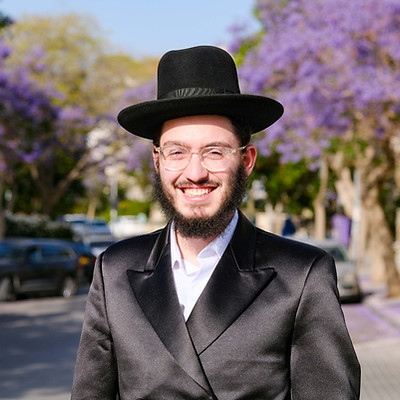
Kalil Shmuel (Kyle) Zaldin
Student, teacher, and proud Jew.
Immersed in the Jewish Day School system since kindergarten at Associated Hebrew Schools and later TanenbaumCHAT, Jewish education has always been a big part of Kalil's life. Kalil has continuously used his Jewish values to inspire others. Having grown up in a Conservative shul until shortly after Bar Mitzvah and later becoming more observant, he writes and teaches timeless Jewish wisdom with the goal of bringing people closer to themselves and their Creator regardless of levels of observance and prior knowledge. A student of Rabbi Moshe Weinberger, the Torah teachings of the great Chassidic masters guide Kalil's life and teachings. He studied in Aish HaTorah and Yeshivas Birchas Mordechai. Kalil is also enrolled in Yeshiva University's Wurzweiler School of Social Work where he is pursuing a Master's degree in Social Work.

Mekadeish Yisrael VeHaZemanim
For far too many, the holidays are overshadowed by feelings of constraint, restriction, isolation, and frustration. What should be times of joy and celebration have become moments of anxiety and dread. Instead of elation at the thought of a three-day Yom Tov, people are often bored, overwhelmed, and scared. Why is this? How have we so tainted the days that Hashem has given us to reconnect with Him? The answer is obvious, but often ignored. We are missing the point of Yom Tov! With all the external trappings, the soul of the Moadim has been lost on us.
Unlike Shabbos, which comes every seventh day whether or not man sanctifies it, the holidays are not predestined, but rather they are sanctified by the People, based on our ability to sanctify time. This is why on Shabbos we use the words “mekadeish haShabbos,” while in our Yom Tov prayers we say, “mekadeish Yisrael ve’hazemanim”. The sanctity of the holidays stems from our inherent holiness. It is my goal that this work, "Mekadeish Yisrael ve'HaZemanim" will help us all to see both our inherent holiness and the meaning and depth of the special and holy days that fill the Jewish calendar.
Why Torah?
Our mosdos are teaching Chumash, Halacha, Gemara, and Mussar, but they are failing to give over the most important aspect of Yiddishkeit, the relationship and connection we have with Hashem. If parents and mechanchim themselves do not know basic foundations of our faith, if Hashem and His goals for the Jewish people and mankind has been so poorly conveyed to them, how can we expect them to teach the beauty of our heritage to the next generation? This short work is an attempt to introduce important concepts in hashkafah and machshavah which lie at the core of what it means to be a Torah observant Jew.
Where G-d and Humanity Touch
Rabbi Tzadok HaKohen Rabinowitz of Lublin famously said: “Just as a person is required to believe in G-d, so too is he afterwards required to believe in himself”. This statement is a guiding principle in my life, and serves as the inspiration for this book. I believe that in order to live a happy, healthy, meaningful, and purposeful life one needs to be attached to something greater than himself, the Creator and Sustainer of all things. As I have learned and experienced, that connection with Hashem is only possible when a person knows and believes in himself.
"Where G-d and Humanity Touch" is a combination of the Torah that I learned and the things that I have experienced on my journey to and through avodas Hashem.
(Haskamos/Approbations were written by Rabbi Moshe Weinberger and the Spinka- Donolo Rebbe. Foreword written by Rabbi Joey Rosenfeld)
Opening Lines
Opening Lines, a compilation of short divrei torah on the first pasuk (or two) of each parsha began as a WhatsApp group shortly after Simchas Torah 5780 (תש״פ). In turn, with the onset of COVID-19 and the global shutdown that occured, these divrei torah were compiled into a small book. As a baal teshuvah, very much involved in Aish HaTorah and NCSY, I know that I have the privilege to learn and understand small portions of the vast wisdom contained within Jewish tradition and thought. I also recognize that I have the incredible opportunity and responsibility to share the Torah that I learn with anyone who is willing to listen. In this book and throughout my life, my goal is to impart emunah and a knowledge of true, authentic Yiddishkeit to my friends, family, and those that listen to me and read what I write.